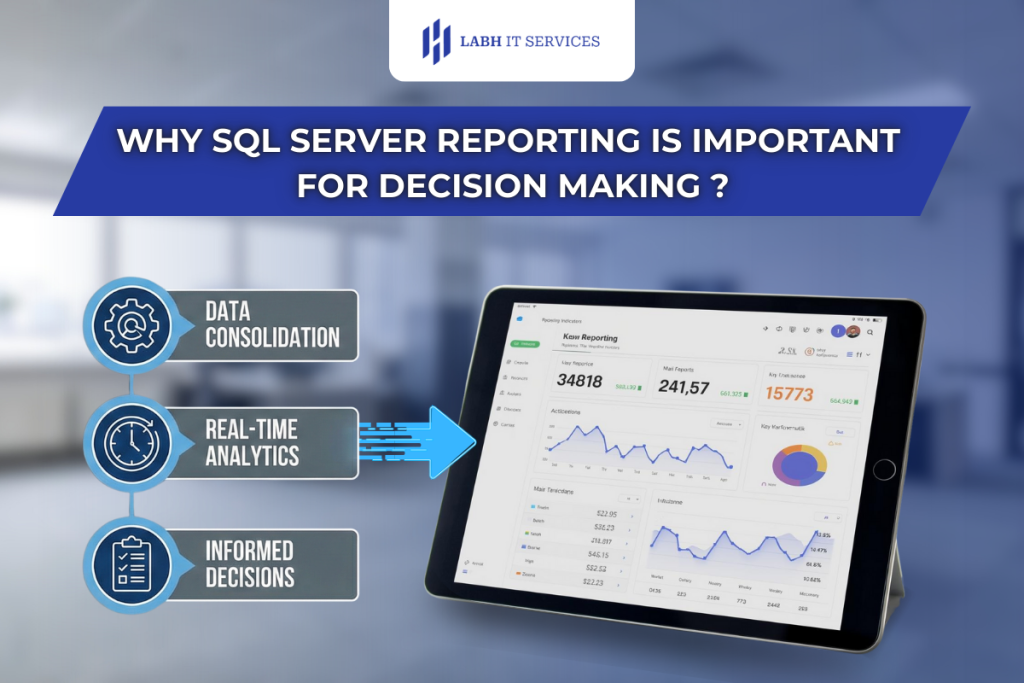
Most business decisions don’t fail because people choose poorly. They fail because the information behind those choices is unclear, incomplete, or arrives too late. Data exists, but it often sits locked inside databases, spreadsheets, or systems that only a few people understand. This is exactly why SQL Server reporting continues to matter for businesses that want to make decisions with confidence rather than guesswork.
At LabH IT Solutions, we regularly work with teams who feel stuck between data and decisions. Reports exist, but they are hard to trust. Numbers change depending on who prepares them. Leaders hesitate because they are not sure which version of the truth to believe. When reporting is built properly, that hesitation disappears. Teams stop arguing over numbers and start focusing on what those numbers are telling them.
Why Decision-Making Breaks Down Without Strong Reporting?
Too much data, not enough clarity
Modern systems collect vast amounts of information, but raw data does not help leaders make decisions. Without structured reporting, data stays scattered and overwhelming.
Delays reduce impact
When reports take days or weeks to prepare, decisions arrive late. By the time insights are ready, the situation has already changed.
Conflicting numbers create doubt
If two teams present different figures for the same metric, confidence drops instantly. Decisions slow down, or worse, stall completely.
These problems don’t always feel dramatic, but over time they quietly affect performance and growth.
What SQL Server Reporting Actually Does?
SQL Server reporting is about turning stored data into something people can understand and use. It bridges the gap between databases and decision-makers.
With sql server reporting, businesses can:
- Pull data directly from reliable sources
- Present information in a structured, consistent format
- Reduce reliance on manual spreadsheets
- Deliver the same insights to everyone
- Support both high-level and detailed analysis
When reporting works well, people spend less time preparing data and more time acting on it.
Why Structured Reporting Improves Decisions?
Consistency builds trust
When everyone sees the same numbers, trust grows naturally. Teams stop questioning the data and start discussing outcomes.
Visibility improves focus
Clear reports highlight what matters most, helping leaders prioritise the right actions.
Historical context supports judgement
Reporting allows teams to see trends over time, not just isolated snapshots.
Better decisions don’t come from more data. They come from clearer insight.
The Role of SSRS in Reliable Reporting
SQL Server Reporting Services plays a key role in delivering structured, repeatable reports across the organisation.
Centralised report management
Reports are created, stored, and managed in one place.
Automated delivery
Reports can run on schedules, reducing manual effort.
Flexible formats
Different users can access reports in formats that suit their needs.
Controlled access
Sensitive data stays secure while remaining accessible to the right people.
This is why many businesses rely on SQL Server reporting services SSRS to maintain consistency and reliability.
How Reporting Supports Everyday Business Decisions?
Decision-making happens daily, not just in boardrooms. Reporting supports those moments more than most people realise.
Operational decisions
Teams adjust workflows based on performance metrics.
Financial decisions
Budgets, forecasts, and spending rely on accurate reporting.
Strategic decisions
Leaders use trends and summaries to plan next steps.
Risk management
Early warnings appear when data is monitored consistently.
When reporting is reliable, decisions feel calmer and more deliberate.
Common Decision-Making Challenges Reporting Helps Solve
Without strong reporting, businesses often face the same frustrations:
- Numbers that don’t match across teams
- Manual report preparation every week
- Delayed insights
- Limited visibility into performance
- Decisions driven by instinct rather than evidence
Structured reporting does not remove complexity overnight, but it gives teams a way to manage it steadily.
How We Approach SQL Server Reporting at LabH IT Solutions?
In the middle of many reporting projects, we notice a familiar pattern. Businesses don’t want more reports. They want fewer doubts. At LabH IT Solutions, we begin by understanding how decisions are actually made. What questions come up repeatedly? Where does uncertainty slow things down?
We design reports that answer those questions directly. Not generic dashboards. Not an unnecessary detail. Just clear, purposeful reporting that fits how teams already work. When reporting aligns with real decision-making, adoption happens naturally.
Why Reporting Accuracy Matters So Much?
Incorrect or inconsistent reports damage confidence quickly. Once trust is lost, even accurate data gets questioned.
Single source of truth
Reporting from one database reduces confusion.
Defined metrics
Clear definitions prevent misinterpretation.
Reduced human error
Automation removes manual mistakes.
Accurate reporting supports confident decisions. Inaccurate reporting creates hesitation.
How SQL Server Reporting Scales with the Business?
As businesses grow, decision-making becomes more complex. Reporting needs to grow alongside it.
Increased data volume
SQL-based reporting handles larger datasets without breaking down.
More users
Reports can be shared across departments without duplication.
Evolving requirements
New metrics and views can be added as needs change.
This scalability is one reason sql server reporting remains relevant for growing organisations.
Reporting as a Foundation for Analytics
Analytics depends on reporting more than many people realise. Before advanced analysis can happen, data needs to be structured and accessible.
Reliable input
Clean reports feed analytics tools accurately.
Faster insight
Structured data reduces processing time.
Better outcomes
Analytics becomes actionable rather than theoretical.
Reporting and analytics work best when built together.
Decision-Making Improves When Reporting Becomes Routine
Reporting delivers the most value when it becomes part of everyday operations.
Regular review cycles
Teams stay aligned when reports are reviewed consistently.
Shared understanding
Everyone interprets performance using the same lens.
Continuous improvement
Insights lead to small adjustments that compound over time.
This routine turns reporting into a habit, not a task.
Why Businesses Still Rely on SSRS Today?
Despite new tools entering the market, SSRS remains widely used because it delivers stability and control.
Proven reliability
Businesses trust systems that perform consistently.
Integration with existing environments
SSRS fits naturally into SQL-based infrastructures.
Cost-effective reporting
It delivers value without unnecessary complexity.
This reliability supports confident decision-making year after year.
Turning Reporting into Better Business Decisions
Reports should not exist for the sake of documentation. Their purpose is to guide action.
With SQL Server Reporting Services SSRS, businesses can:
- Identify trends early
- Measure performance accurately
- Reduce uncertainty
- Support planning
- Make informed decisions faster
When reporting work, decision-making feels less stressful and more focused.
Move Forward with LabH IT Solutions
If your business struggles with slow decisions, conflicting numbers, or unreliable reports, the issue often lies in reporting foundations. With the right approach, reporting becomes a tool for clarity rather than confusion.
At LabH IT Solutions, we help businesses strengthen SQL Server reporting using dependable SQL Server reporting services, so decisions are based on insight, not assumption.
Contact us to get started.
FAQs
What is the main benefit of using reports for decision-making?
Reports provide clear, structured insight that supports confident and informed decisions.
What are the benefits of an SSRS report?
SSRS reports offer consistency, automation, security, and reliable data delivery.
What is the use of SQL Server Reporting Services?
It is used to create, manage, and deliver structured reports from SQL databases.
What are the benefits of data reporting?
Reporting improves visibility, accuracy, and alignment across teams.
How can data reporting improve decision-making?
It reduces guesswork by providing timely, reliable information teams can trust.