When businesses start looking for external IT support, it’s rarely because everything is running perfectly. Something feels off. Systems feel heavier than they should. Decisions around technology feel unclear. Internal teams feel stretched. That’s usually the point where the search for an IT consulting company begins. Not to add more tools, but to bring clarity and direction into an environment that has grown complicated over time.
At LabH IT Services, we often meet companies at exactly that stage. Technology is already in place, but it no longer feels aligned with how the business actually works. Processes have layered over the years. Systems don’t connect cleanly. Teams adapt around limitations instead of being supported by their tools. Professional consulting changes that experience. It helps businesses step back, see the full picture, and move forward with confidence instead of patchwork fixes.
Why Businesses Turn To IT Consulting In The First Place
Businesses rarely seek consulting just to follow trends. There is usually a practical reason underneath.
Sometimes systems have grown too complex. Sometimes reporting feels unreliable. Sometimes teams are spending more time maintaining technology than using it. In other cases, leadership knows change is needed but isn’t sure where to start. These situations create friction that slows decisions and productivity.
A professional consulting partner brings perspective that internal teams often can’t step back far enough to see. Not because they lack skill, but because they’re embedded in day-to-day operations. That outside view is often the first real shift.
What A Professional IT Consulting Company Actually Does
There’s a common misconception that consultants simply recommend new software or infrastructure. In reality, their role is broader and more grounded in business outcomes.
A capable IT consulting company typically focuses on:
- Understanding how technology currently supports the business
- Identifying gaps, inefficiencies, and risks
- Aligning systems with real operational needs
- Designing improvements that are practical and sustainable
- Guiding implementation without disruption
The emphasis stays on usefulness rather than novelty. Technology should support work, not complicate it.
The Difference Between Advice And Real Consulting
Not all consulting feels the same. Some engagements stay theoretical. Others translate directly into operational improvement. The difference usually comes down to how deeply the consultant understands the business itself.
Real consulting doesn’t start with tools. It starts with questions. How do teams actually work? Where do delays happen? What decisions feel uncertain? What workarounds exist? When consultants understand these realities, recommendations become grounded instead of generic.
This is why strong business IT consulting services rarely feel abstract. They feel relevant almost immediately.
What You Should Expect In The Early Stages
The first phase of professional consulting often sets the tone for everything that follows.
You should expect careful listening rather than quick conclusions. Consultants should spend time understanding workflows, systems, reporting processes, and decision points. This stage often reveals issues that have become normal internally but stand out clearly to an external partner.
Typical early activities may include:
- Reviewing current systems and integrations
- Mapping how data flows across teams
- Identifying bottlenecks or duplication
- Understanding reporting and visibility gaps
- Clarifying business priorities
This groundwork ensures later recommendations are realistic.
How Professional Consulting Improves Daily Operations
Consulting is often associated with strategy, but its impact is felt most in everyday work.
When systems align better with processes, teams spend less time navigating friction. Reporting becomes clearer. Decisions require less back-and-forth. Tasks that once felt slow become routine again. These changes rarely feel dramatic individually, yet collectively they reshape productivity.
Businesses often notice improvements such as:
- Reduced manual work
- Faster access to information
- Fewer system frustrations
- Clearer ownership of processes
- More predictable workflows
These are practical shifts, not theoretical ones.
Where LabH IT Services Fits Into This Journey
In many engagements, we notice the same pattern. Businesses don’t necessarily need more technology. They need better alignment. At LabH IT Services, we focus on understanding how teams already operate before suggesting changes. This keeps consulting grounded in reality rather than assumptions.
We look closely at where technology supports work and where it quietly obstructs it. Sometimes the answer is simplification. Sometimes integration. Sometimes, restructuring data or reporting flows. The direction always depends on what the business actually needs, not what tools are available.
Signs Of A Truly Professional Consulting Partner
Choosing the right partner matters as much as the work itself. Professional consulting has certain clear traits.
A strong partner will:
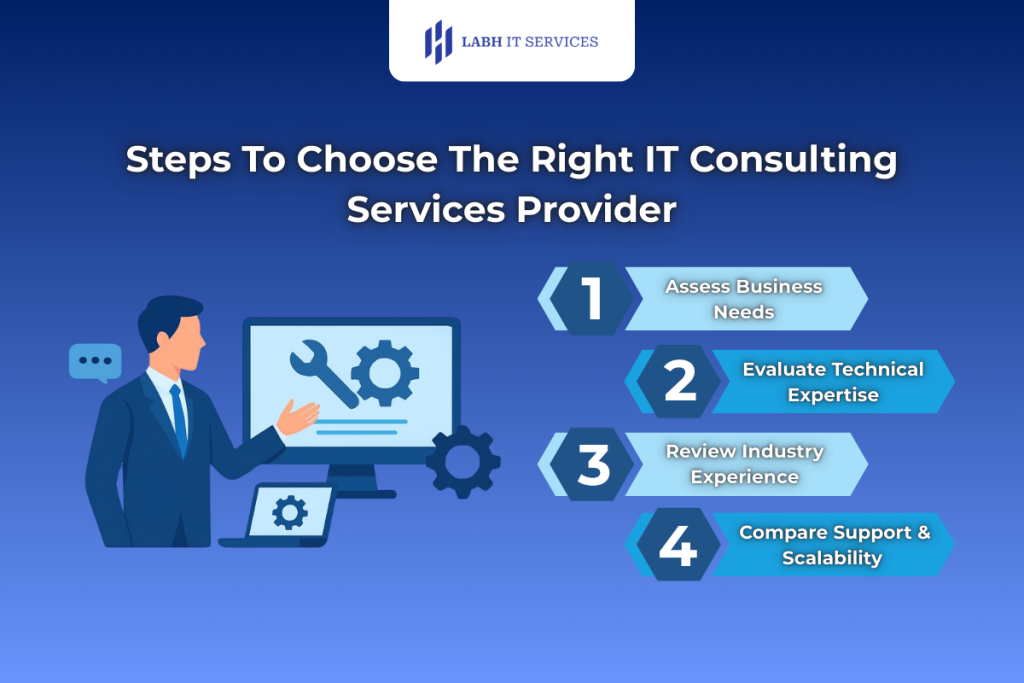
- Prioritise understanding before recommending
- Explain decisions in plain language
- Align technology with business goals
- Focus on sustainability, not quick fixes
- Stay engaged through implementation
These qualities separate genuine consulting from surface-level advice.
How Business IT Consulting Services Support Growth
Growth introduces complexity. New systems, new processes, new data flows. Without alignment, that complexity becomes difficult to manage.
This is where business IT consulting services support scaling businesses. They help ensure systems expand logically rather than chaotically. Integrations remain clean. Reporting stays consistent. Teams continue to operate smoothly even as operations grow.
Growth supported by aligned technology feels controlled rather than stressful.
Common Misconceptions About IT Consulting
Many businesses hesitate because of assumptions about consulting. These concerns are understandable but often misplaced.
Some believe consultants only recommend expensive tools. Others assume engagement will disrupt operations. Some worry internal teams will be sidelined. In reality, effective consulting does the opposite. It clarifies existing investments, reduces disruption, and strengthens internal capability.
Professional consulting works with teams, not around them.
What Long-Term Value Looks Like
The true value of consulting often appears over time rather than immediately.
Systems become easier to maintain. Reporting remains consistent. Decisions rely on stable data. New initiatives integrate smoothly. Technology discussions shift from reactive fixes to planned improvements. These are indicators that alignment has taken hold.
Businesses often experience long-term outcomes such as:
- Greater operational stability
- Clearer technology roadmap
- Reduced technical debt
- Improved decision confidence
- Better return on existing systems
This sustained clarity is what defines successful consulting.
Preparing Your Business For Consulting Success
Consulting works best when businesses approach it with openness rather than the expectation of quick fixes.
Clarity about goals helps. Willingness to examine processes helps. Honest discussion of challenges helps. Consulting is most effective when treated as collaboration rather than outsourcing.
When both sides engage fully, outcomes become far more meaningful.
Building A Stronger Technology Foundation With LabH IT Services
If your business feels slowed by systems that no longer align with how you operate, professional guidance can bring much-needed clarity. Consulting is not about replacing everything. It is about ensuring that what you have supports where you want to go.
At LabH IT Services, we provide business IT consulting services designed around real workflows, practical improvements, and long-term stability.
Let’s explore how your technology can start supporting your business more naturally.
FAQs
What does an IT consulting company do?
It evaluates systems, identifies gaps, and aligns technology with business needs.
How do business IT consulting services help companies?
They improve processes, integrate systems, and support growth with aligned technology.
When should a business hire IT consultants?
When systems feel inefficient, complex, or misaligned with operations.
Do consultants replace internal IT teams?
No, they support and strengthen internal teams with expertise and perspective.
How long does IT consulting usually take?
It varies, but many engagements deliver value in phases over time.