As businesses grow, technology stops being a background function and starts becoming central to how work gets done. Systems affect speed, collaboration, security, and decision-making. This is usually the point where leaders begin to question whether their current setup is actually helping or quietly slowing things down. That is where it consulting services come into focus. They are not about adding more tools, but about making sure the technology you rely on genuinely supports your business.
At LabH IT Services, we often meet teams who feel busy but not always productive. Technology is in place, yet processes feel heavier than they should. Decisions take longer, data is scattered, and small technical issues keep interrupting daily work. Professional IT consulting helps step back, review the bigger picture, and bring clarity where things have become messy over time.
Why Businesses Turn to IT Consulting?
Technology grows faster than planning
Most organisations adopt tools as needs arise. One system solves one problem, another is added later, and soon the overall setup becomes difficult to manage. Without a clear plan, technology starts working against productivity.
Internal teams can only do so much
In-house teams are often focused on keeping things running. They may not have the time or space to step back and rethink systems from a strategic angle.
Small inefficiencies add up
Minor issues don’t always feel urgent, but over time they slow teams down. IT consulting helps identify and fix those problems before they grow.
These are common reasons businesses start looking for outside support.
What Professional IT Consulting Services Really Offer?
At its core, IT consulting is about alignment. It ensures technology decisions match business goals instead of sitting in isolation.
With it consulting services, businesses typically gain:
- A clear understanding of their current technology setup
- Guidance on what to improve, replace, or simplify
- Better integration between systems
- Reduced technical risk
- Support for future growth
The focus is not on complexity. It is on making technology feel manageable again.
How IT Consulting Improves Day-to-Day Operations?
Clearer processes
When systems are designed with intention, work flows more smoothly. Teams spend less time figuring out how to do things and more time actually doing them.
Better use of existing tools
Many businesses already have strong software in place but don’t use it fully. Consulting helps unlock that value instead of layering on more tools.
Less manual work
Automation and smarter workflows reduce repetitive tasks that drain time and energy.
Improved communication
When systems talk to each other properly, teams stay aligned and informed without constant follow-ups.
These improvements are often felt quickly, especially in growing teams.
The Role of Data in Effective IT Consulting
One of the most overlooked areas in productivity and decision-making is data. Businesses collect large volumes of information, but it is not always easy to access or trust.
This is where data services in Uk play an important role. When data is structured properly, teams gain faster insights and make decisions with more confidence.
How strong data services support consulting outcomes?
Better visibility
Teams can see performance clearly instead of relying on assumptions.
Faster reporting
Automated data flows reduce delays and errors.
Stronger decision-making
Reliable data supports planning and strategy at every level.
Improved collaboration
When everyone works from the same data, alignment improves naturally.
Without a solid data foundation, even the best tools fall short.
Where LabH IT Services Brings Value?
In the middle of many consulting engagements, we notice the same pattern. Businesses don’t need more technology. They need clarity. At LabH IT Services, we start by understanding how teams actually work, not how systems are supposed to work on paper. This helps us design solutions that fit naturally into daily operations.
We focus on practical improvements that reduce friction. Sometimes that means simplifying systems. Sometimes it means improving data flow. Sometimes it means guiding teams through change more smoothly. The goal is always the same: make technology feel like support, not a burden.
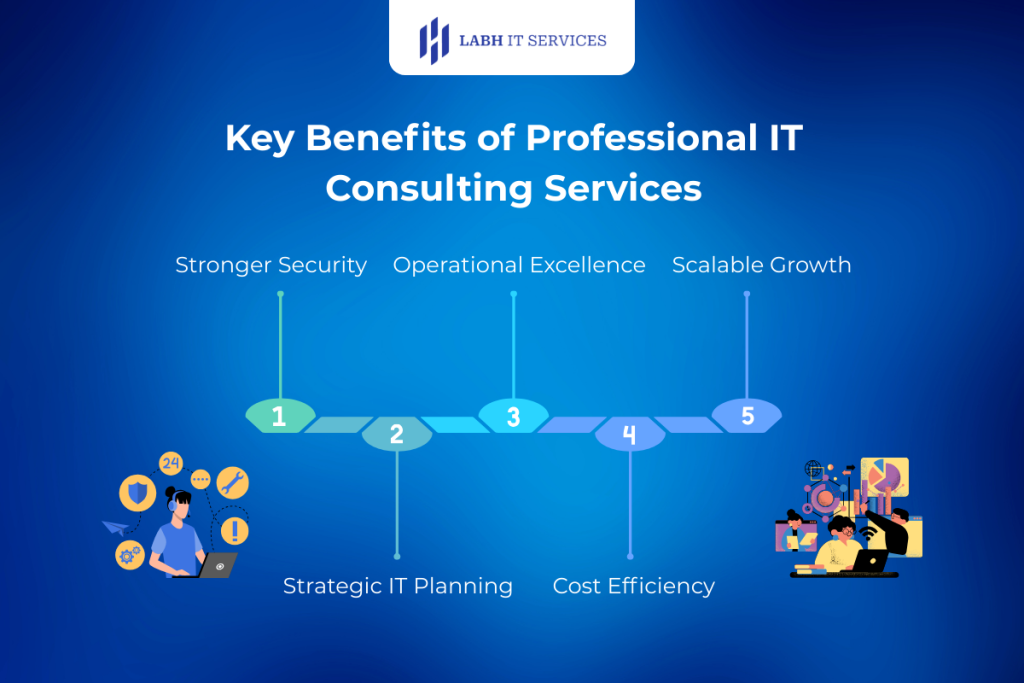
Key Benefits Businesses Experience After IT Consulting
Here are some of the most common outcomes we see once businesses invest in professional consulting:
- Reduced downtime and fewer technical disruptions
- Clearer ownership of systems and processes
- Faster access to information
- Better security practices
- Improved scalability
- More confident decision-making
Each benefit on its own matters, but together they transform how a business operates.
IT Consulting and Long-Term Business Growth
Scalable systems
As businesses grow, systems should grow with them. Consulting helps design technology that adapts instead of breaking under pressure.
Better planning
Clear visibility into systems and data supports smarter long-term planning.
Reduced future costs
Fixing inefficiencies early prevents expensive rework later.
Stronger resilience
Well-designed systems recover faster from issues and changes.
Growth becomes easier when technology is built with intention.
Why Consulting Is About More Than Technology?
Good consultants don’t just talk about tools. They focus on people, processes, and outcomes.
Understanding business goals
Technology should support where the business is heading, not dictate it.
Clear communication
Consultants need to explain things simply so teams stay confident and involved.
Adaptability
Every business changes. Consulting works best when it evolves alongside those changes.
This human side of consulting often makes the biggest difference.
Common Mistakes Businesses Avoid with IT Consulting
Professional guidance helps businesses steer clear of issues that quietly cause problems over time.
These include:
- Investing in tools that don’t scale
- Overcomplicating systems
- Ignoring data quality
- Delaying security improvements
- Relying too heavily on manual processes
Avoiding these mistakes saves time, money, and frustration.
How IT Consulting Supports Different Teams?
IT consulting benefits the entire organisation, not just leadership.
Management
Gain clarity into performance and operations.
Operations
Reduce bottlenecks and inefficiencies.
Finance
Improve visibility into costs and planning.
Sales and marketing
Access better insights into performance and customer behaviour.
IT teams
Reduce reactive work and focus on improvement.
When everyone benefits, adoption becomes easier.
Why Data Services Are Central to Modern Consulting?
Modern consulting is closely tied to data. Without reliable data, decisions rely too heavily on instinct.
With data services Uk, businesses can:
- Build consistent data foundations
- Improve reporting accuracy
- Support analytics and forecasting
- Reduce risk from poor data quality
Data becomes a strategic asset rather than a constant challenge.
Move Forward with LabH IT Services
If your business is looking to reduce friction, improve clarity, and make technology work more effectively, professional consulting can help. With the right approach, IT consulting becomes a long-term advantage rather than a short-term fix.
At LabH IT Services, we provide it consulting services that focus on practical outcomes, not unnecessary complexity. By combining strategic thinking with reliable data services Uk, we help businesses build systems that support growth and confidence.
Contact us to get started.
FAQs
What are the benefits of IT consulting services?
They help businesses improve efficiency, reduce risks, and align technology with business goals.
What are the 5 C’s of consulting?
They include clarity, communication, competence, collaboration, and credibility.
What is the rule of 3 in consulting?
It encourages presenting three clear options to simplify decision-making.
What are the three main qualities of a consultant?
Strong communication, problem-solving ability, and adaptability.
What are the most important skills for a consultant?
Strategic thinking, technical understanding, and the ability to work well with people.