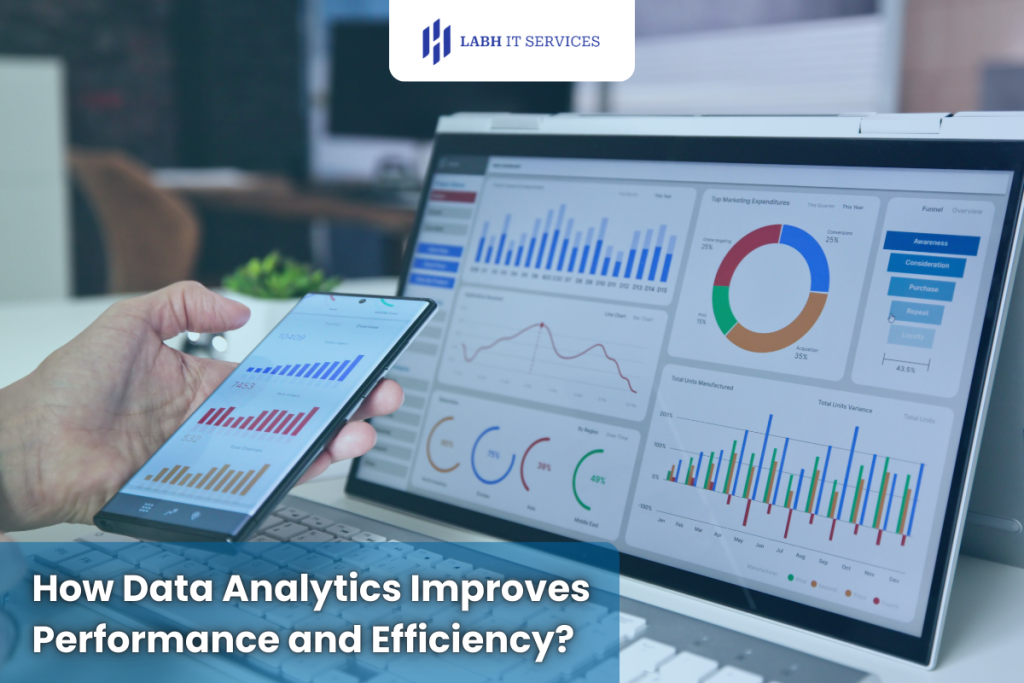
Most businesses today are busy. Teams are working hard, systems are running, and data is being collected constantly. Yet despite all that effort, performance often feels uneven. Tasks take longer than expected. Decisions get delayed. Opportunities are missed. This is where data analytics starts to make a real difference. It helps businesses understand what is actually happening inside their operations and where time, effort, and resources are being lost.
At LabH IT Services, we regularly speak with organisations that know data should be helping them more than it currently does. They have reports, dashboards, and spreadsheets, but there is still hesitation when it comes to making decisions. People second-guess numbers or rely on instinct because the data doesn’t feel clear enough. When analytics is approached properly, that uncertainty fades. Performance improves not because people work harder, but because they work smarter.
Why Performance and Efficiency Often Suffer?
Data exists without direction
Most businesses collect data automatically, but without a clear purpose, it becomes noise. Teams spend time gathering numbers instead of using them.
Inefficiencies stay hidden
Without visibility, small inefficiencies go unnoticed. Over time, they add up and quietly slow the business down.
Decisions rely on assumptions
When insight is missing or delayed, decisions fall back on experience and guesswork. That works sometimes, but it’s risky.
These challenges don’t usually appear overnight. They build gradually, which is why analytics becomes more important as businesses grow.
What Data Analytics Really Does for a Business?
Data analytics is not about creating endless charts. It’s about understanding performance at a deeper level.
In practical terms, data analytics helps businesses:
- Identify patterns in operations and behaviour
- Measure performance accurately
- Highlight inefficiencies early
- Support faster, more confident decisions
- Align teams around shared insights
When analytics works, it becomes part of everyday thinking rather than a separate task.
How Analytics Improves Operational Performance?
Clear visibility into processes
Analytics shows how work actually flows through the business, not how it’s assumed to flow.
Faster problem identification
Issues appear in the data before they become serious problems.
Better prioritisation
Teams focus on areas that genuinely impact results instead of spreading effort thin.
These improvements make performance more consistent and predictable.
The Link Between Data Analytics and Efficiency
Efficiency is not just about speed. It’s about reducing waste and friction.
Less manual work
Automation and structured data reduce repetitive reporting tasks.
Fewer errors
Clean data and consistent metrics lower the risk of mistakes.
Smarter resource use
Time, budget, and people are allocated based on evidence, not assumptions.
This is where analytics quietly transforms how efficiently a business operates.
Why Analytics Matters Across the Organisation?
Data analytics does not belong to one department. Its impact spreads everywhere.
Operations
Analytics highlights bottlenecks and inefficiencies.
Finance
Teams gain clearer insight into costs, forecasts, and trends.
Sales
Performance tracking becomes more accurate and timely.
Marketing
Campaign results and customer behaviour become easier to understand.
Leadership
Decisions are grounded in evidence rather than instinct.
When everyone works from the same insight, alignment improves naturally.
How We Approach Data Analytics at LabH IT Services?
In the middle of many analytics projects, we notice something important. Businesses don’t want more data. They want clarity. At LabH IT Services, we start by understanding what performance really means for the organisation. What slows teams down? Where does effort feel wasted? What decisions cause the most uncertainty?
From there, we design analytics that answer real questions. Not generic dashboards. Not an unnecessary detail. Just clear insight that fits into daily work. When analytics feels relevant, teams use it without being pushed.
Turning Insight into Action
Analytics delivers value only when it leads to action.
Regular performance reviews
Teams stay aligned when insights are reviewed consistently.
Clear ownership
Defined responsibility ensures data stays accurate and useful.
Continuous improvement
Small adjustments based on insight compound over time.
This cycle turns analytics into a habit rather than a one-off project.
The Role of Data Analytics in Business Efficiency
Efficiency improves when teams can see where effort is being wasted.
With data analytics business practices in place, organisations can:
- Reduce duplication of work
- Streamline workflows
- Improve response times
- Identify underperforming areas early
Efficiency becomes measurable instead of assumed.
Why Analytics Supports Long-Term Growth?
As businesses grow, complexity increases. Analytics helps manage that complexity.
Scalable insight
Systems grow with data volumes.
Better planning
Historical trends support forecasting.
Reduced risk
Early signals highlight issues before they escalate.
Growth feels more controlled when supported by insight.
Common Performance Challenges Analytics Helps Solve
Without analytics, businesses often struggle with:
- Conflicting reports across teams
- Slow decision-making
- Limited visibility into performance
- Over-reliance on manual reporting
- Difficulty measuring improvement
Analytics does not remove all challenges instantly, but it provides a clear framework to address them.
Why Data Analytics Is a Strategic Asset?
Data becomes valuable only when it improves outcomes.
With data analytics business insight, organisations gain:
- Faster decision cycles
- Improved efficiency
- Better accountability
- Stronger performance tracking
Analytics shifts from being a technical function to a strategic capability.
Building a Culture Around Data
Analytics works best when it becomes part of how people think.
Confidence in numbers
Teams trust what they see.
Curiosity
Questions are explored using data, not guesswork.
Shared understanding
Everyone interprets performance using the same context.
This cultural shift is often the biggest long-term benefit.
Turning Insight into a Competitive Advantage
When performance and efficiency improve, competitiveness follows.
With data analytics, businesses can:
- Respond faster to change
- Improve internal processes
- Deliver better customer experiences
- Support a smarter strategy
Analytics becomes a quiet but powerful advantage.
Where to Take the Next Step
If your business feels busy but not always efficient, analytics can help uncover why. With the right approach, insight replaces uncertainty and performance becomes easier to manage. At LabH IT Services, we help organisations use data analytics and data analytics business insight to improve efficiency without adding complexity.
Start a conversation with us and see how insight can change the way your business performs.
FAQs
What is data analytics, and why is it important?
It helps businesses understand data, identify patterns, and make informed decisions.
How does data analytics improve business performance?
It highlights inefficiencies, supports better decisions, and improves focus.
What is data analytics used for?
It supports performance tracking, efficiency improvement, and strategic planning.
Is data analytics useful for small businesses?
Yes, it helps smaller teams work smarter and track progress clearly.
How do businesses get started with data analytics?
They begin by defining goals, organising data, and building simple, reliable insights.