Most businesses today don’t struggle with collecting data. They struggle with using it properly. Data lives everywhere: in tools, platforms, applications, and databases; yet teams still find themselves guessing or double-checking numbers before making decisions. That is usually when cloud data engineering starts to matter. It doesn’t add more data. It brings order to what already exists and makes it usable.
At LabH IT Services, we often speak with teams who feel overwhelmed by information but still lack clarity. Reports take time. Systems don’t connect cleanly. People rely on manual fixes just to answer simple questions. Over time, that friction becomes normal, even though it shouldn’t be. Cloud-based data engineering changes that experience by creating a structure where data flows smoothly and supports day-to-day work instead of slowing it down.
Why Traditional Data Setups Start Holding Businesses Back?
Data grows faster than systems
Many organisations began with setups that worked well in the early days. As data volumes increased, those systems struggled. Performance dipped, maintenance became expensive, and flexibility disappeared.
Information spreads across too many places
Different teams store data in different tools. Over time, numbers stop matching. Trust fades. Meetings turn into discussions about accuracy instead of outcomes.
Reporting becomes frustrating
When pipelines aren’t reliable, reporting slows down. Teams wait for answers instead of acting on them.
These issues don’t always show up overnight, but they quietly limit how effective a business can be.
What Cloud Data Engineering Actually Changes?
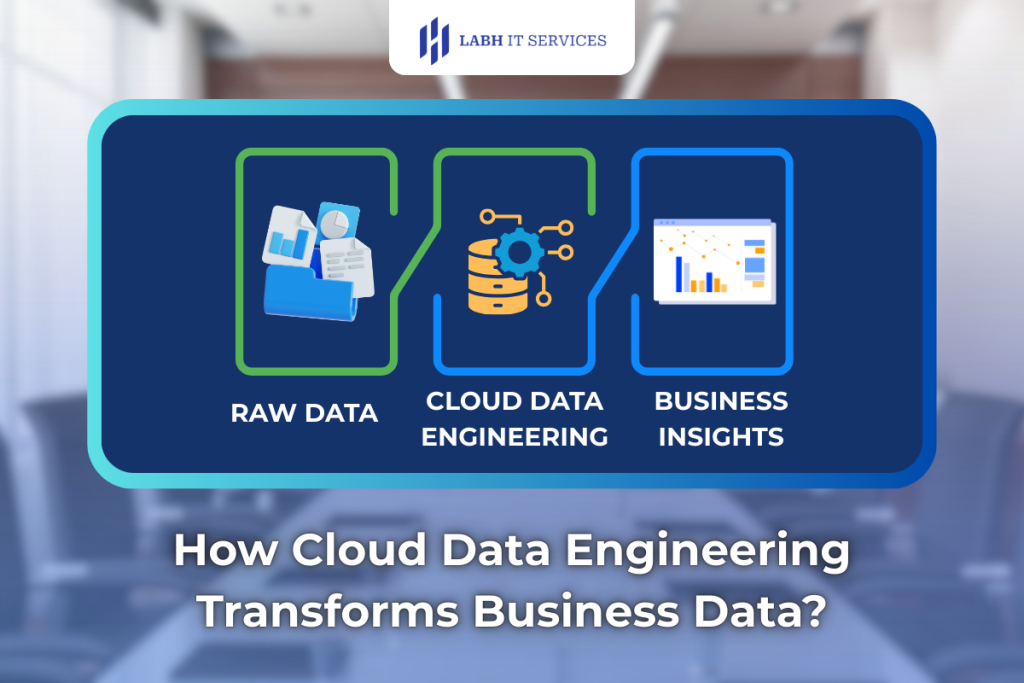
Cloud data engineering is not just about moving data into the cloud. It’s about redesigning how data moves through the business.
With cloud data engineering, businesses can:
- Bring data from multiple sources into one environment
- Process large volumes without performance issues
- Replace manual steps with automated pipelines
- Improve consistency and data quality
- Scale systems as the business grows
The technical shift is important, but the real change is how teams interact with data every day.
How Data Engineering Services Support Real Transformation?
Data engineering sits underneath analytics, reporting, and insight. When it’s missing or weak, everything built on top of it feels unstable.
Clean data leads to clearer outcomes
Engineering ensures data is structured and validated before anyone uses it.
Faster access to information
Well-designed pipelines reduce delays and remove unnecessary steps.
Less operational friction
Automation replaces repetitive tasks that drain time and focus.
This is why data engineering services play such a critical role. They create systems that teams can rely on, not constantly work around.
Why the Cloud Makes Data Engineering Work Better?
Flexibility without heavy investment
Cloud platforms let businesses adjust storage and processing power without major upfront costs.
Built-in scalability
As data grows, systems expand naturally instead of needing constant redesign.
Easier collaboration
Teams can access shared data securely from different locations.
Stronger support for modern tools
Cloud environments integrate easily with analytics, reporting, and automation platforms.
These benefits explain why so many businesses are shifting their data strategies to the cloud.
How We Approach Cloud Data Engineering at LabH IT Services?
In the middle of most transformation projects, we see the same pattern. Businesses don’t need more dashboards or more data. They need better flow. At LabH IT Services, we start by understanding how data is currently used, not how it’s supposed to be used on paper.
We look at where data comes from, how it moves, and where it slows down. From there, we design cloud-based pipelines that remove friction instead of adding layers. The goal is always the same: make data easier to trust and easier to use across the business.
Practical Benefits Businesses Notice Over Time
Once cloud data engineering is in place, the impact becomes visible fairly quickly.
Businesses often see:
- Faster reporting cycles
- Fewer inconsistencies in data
- Improved system performance
- Lower maintenance effort
- Better scalability for growth
- Stronger support for analytics
Each improvement may feel small on its own, but together they change how confidently teams work with data.
Better Decisions Start with Better Data Flow
Decisions improve when information is timely and reliable. Cloud-based pipelines help ensure data stays current and consistent across teams.
Less time questioning numbers
Teams stop validating reports repeatedly.
Clearer performance tracking
Metrics remain consistent across departments.
More confident planning
Both historical and real-time data support better forecasting.
This shift turns data into something teams can act on, not something they constantly second-guess.
How Data Engineering Services Reduce Business Risk?
Poor data quality introduces risk into almost every decision. Cloud-based engineering reduces that risk through structure and automation.
Shared data definitions
Everyone works from the same understanding of metrics.
Automated checks
Errors are caught early, before they reach reports.
Controlled access
Sensitive data stays secure without blocking collaboration.
With these foundations in place, confidence naturally increases.
Supporting Growth with Cloud-Based Data Systems
Growth often exposes weaknesses in data systems. Cloud data engineering helps businesses prepare before those cracks appear.
Systems that grow with demand
Pipelines scale without needing constant redesign.
Faster onboarding of new data sources
New tools integrate more smoothly.
Better cost control
Pay-as-you-grow models reduce unnecessary spending.
This flexibility makes cloud-based engineering a strong long-term choice.
Turning Data into a Real Business Advantage
Data only becomes valuable when it supports action. Cloud data engineering ensures information reaches the right people at the right time.
With cloud data engineering, businesses can:
- Respond faster to change
- Improve operational efficiency
- Strengthen reporting and analytics
- Support long-term planning
Combined with reliable data engineering services, data stops being a technical challenge and starts becoming a strategic asset.
Move Forward with LabH IT Services
If your business wants better data flow, less manual effort, and clearer insight, cloud-based data engineering is a strong step forward. With the right foundation, it brings stability today and flexibility for tomorrow.
At LabH IT Services, we design data engineering services that make the most of cloud data engineering, without unnecessary complexity or noise.
Contact us to get started.
FAQs
How has cloud computing transformed the way businesses operate?
It has improved flexibility, reduced infrastructure costs, and made data and systems easier to access.
What is data transformation in data engineering?
It involves cleaning, structuring, and preparing raw data so it can be used reliably.
What is the role of cloud computing in business transformation?
Cloud computing supports scalability, automation, and faster innovation.
How to use cloud computing for a business?
Businesses use it to store data, run applications, automate workflows, and support analytics securely.